
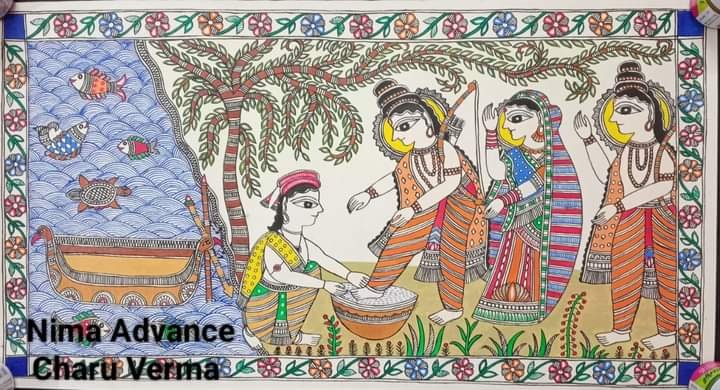
Photo courtesy: Charu Verma (National Institute of Mithila Art)
Madhubani Painting, Origin and History–
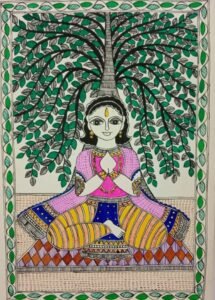
Madhubani painting, also known as Mithila painting, is a reflection of India’s artistic heritage. It represents the cultural identity of the Maithili women of Bihar, where artists create intricate paintings with brushes, twigs, matchsticks, or their fingers.
Traces of Madhubani art can also be noticed in the Ramayana.
o Madhubani paintings are popular for their tribal motifs and use of bright earthy colors. Traditionally the women of the village drew these paintings on the walls of their dwelling, as a demonstration of their feelings, hopes, and ideas.
o The colors used in paintings comprises natural extracts from plants and other natural sources. Black color is obtained by mixing soot with cow dung, blue from indigo, white from rice powder, orange from palasha flowers.
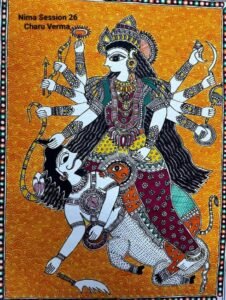
o Themes of Madhubani paintings are based on the mythological characters which depict the life of Hindu deities like Krishna, Rama, Lakshmi, Shiva, Durga, and Saraswati.
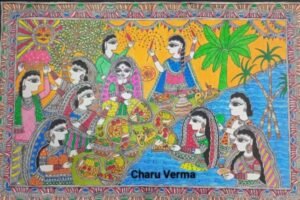
Madhubani painting became famous in 1970 when Mrs. Jagdamba Devi from the village Jitwarpur, got an award from the President of India. Mrs. Sita Devi and Mrs. Mahasundari Devi, were also national award winner, for their contribution in the field of Madhubani painting.
Mrs. Dulari Devi has been awarded with Padma Shri in the year 2021 for her immense contributions to the Mithila folk art.
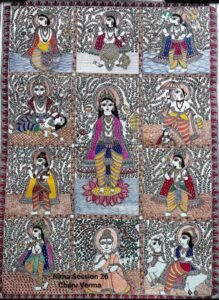
Photo courtesy: Charu Verma (National Institute of Mithila Art)
Madhubani Painting, Origin and History
Madhubani painting is said to have developed in the ancient city of Mithila, the birth place of Sita. It is believed that King Janak (father of Sita) commissioned artists to depict his daughter Sita’s wedding. When Lakshmana went to the forest along with Rama and Sita, his wife Urmila painted his image on the wall and worshipped it daily.
For generations, the Madhubani art skills have been passed on from mother to daughter. To ensure continuity of this art tradition, paper patterns are made so that she can take with her husband’s house. She adds new elements in present style of her husband’s house. There are two types of Madhubani painting, first is done by Brahmana and second by Kayastha, both are different from each other in style and color. They have preserved their qualities and distinctive character from the beginning till date.
In 1934 the place Madhubani faced a big earthquake. In 1960, few members of the Indian Handicrafts Board visited Madhubani for survey. They were attracted by the wall painting of Madhubani. They gave suggestions to some local artisans to paint on cloth and paper in their traditional way. They also encouraged the women of Madhubani for commercial sale. After that Madhubani artist started painting on cloth and paper except on walls.
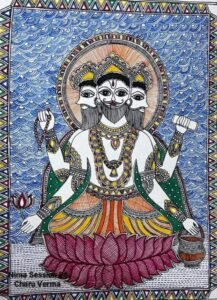
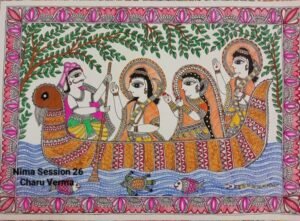
Madhubani painting is mainly mastered by women only. Brahmana ladies had a very good aesthetic sense, which can be seen in the wall decoration of their houses. The main purpose of this art was to satisfy deep urge to express their own and get rid of from their monotonous life. Madhubani painting has a practical usefulness also. On the occasion of social and religious festivals, Madhubani painting is the medium to convey the message of prosperity and purity. Every ritual is incomplete without Madhubani painting. Madhubani painting is not a classical art, it is the simple folk art with simple expression of women folk, they have no principals and instructions from any art book to follow, their own Idea and imagination is the important factor. All Madhubani artists have their own idea of representation but the style remains the same. Madhubani painting is the integral part of family rituals and transferred from one generation to another generation.
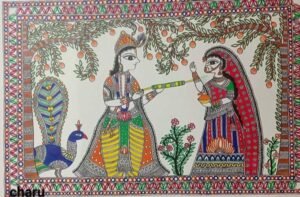
Madhubani painting is a folk art of Mithila but it is not limited in small area of Mithila, this art has become very famous not only in India but in foreign countries also. From beginning it has some unique style, which makes this art very special from other folk arts. Madhubani painting is filled with the rhythm of life.
All figures and elements of this art related with each other. Painting of Brahmana and the painting of Kayastha has some unique characteristics which make them different from each other. In Brahmana’s painting color is the most important thing but in Kayastha painting, lines are given more importance than colors. Brahmana’s paintings have a very thin and weak line but Kayastha paintings have a firm and vigorous line.
Madhubani Painting, Origin and History
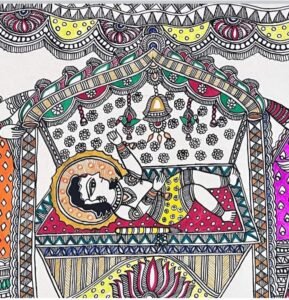
Madhubani painting has a several styles on the bases of different caste. ‘Bharni’ is the style of Madhubani practiced by Brahmanas, they filled the bright color in mythological figures and outlined the figures with bold black color.
‘Kachni’ is the style of Kayastha, in their painting lines are more dominating than colors.
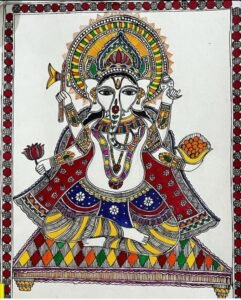
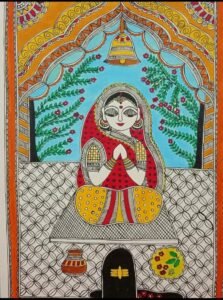
‘Geru and Godhna’ is the style of lower caste. They belong to lower caste so they are restricted to depict the religious designs. The subject matter of Madhubani painting is religious and related with nature. In India religion has a great impact on art, Madhubani painting is not the exception. It is very religious and has an influence of Shiva, Vishnu and Shakti. Durga and Kali are the important goddesses of Mithila Brahmana and Kayastha artisans. Religious Madhubani painting contains various gods and goddesses like Rama and Sita, Radha and Krishna, Shiva and Parvati, Gauri and Ganesha, Durga and Kali, Ravana, the ten Avataras, the sun and the moon.
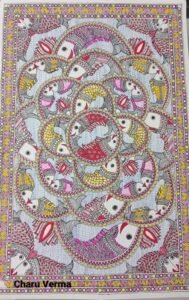
Madhubani painting is very much inspired by the nature. It takes the motifs from nature and represents them in a decorative manner. Decorative painting contains various symbols of prosperity and fertility such as elephant, lion, fish, horse, turtle, parrot, bamboo, flowers, lotus, swastika, series of circles, spirals, series of short lines and foot prints. While the human figures are mostly abstract and linear in form but animals are usually naturalistic.
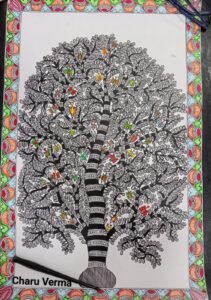
Madhubani painting, Mithila painting-Symbolic Art in Madhubani painting
There are so many symbols, which have very deep meaning. In the depiction of animals, they want to represent the energy and character of God. In Indian context, the parrots symbolize the love birds. Turtle is the symbol of lover’s union. Fishes are the symbol of fertility and the sun and the moon are depicted in painting because of their life granting qualities. Lotus and bamboo is the symbol of female and male. Colors are the most important factor in Madhubani painting and plays a vital role in the creation of these simple images. Colors creates the emotion, atmosphere and mood, they also divide the space, beautify the background. Only pure colors or generally two or five colors – green, yellow, red, black and blue are applied flat with no shading in Madhubani painting, but the colors are used in the same tone and simplified the images. Madhubani painting does not bear the realistic colors of figures, they have used the colors in a symbolic way. There is normally a double line drawn for the outlines with the gap, between the lines filled by cross or straight tiny lines. Colors have the religious influences, for example, the figure of Krishna is black. But sometimes, in many cases we come across a normal color. Colors are distorted, not used for realistic description. To paint, artist uses fingers, matchsticks and pen nibs and don’t leave any blank space in painting.
Madhubani painting, Mithila painting-Geometrical distortion
Geometrical distortion in figures, develop the geometric energy in Madhubani painting, “Which is vividly manifest in the bust of Parvati and the thighs and legs of Shiva resulting in a system of rigid triangles.” In another example, a tiger and a bamboo reduced to curling spirals and in a third the waists of two figures depicted as opposing semi circles and Durga has been shown as a set of semi circles, triangles and rounded squares.
Strange Figures Distorted, strange figures are the main characteristic of Madhubani painting. Distortion gives the figures, a fantastic strangeness. There are some strange features in Madhubani paintings, such as, nose in the forehead, eye in the profile, receding brows and staring eyes. In the painting of Bua Devi, some kind of strangeness can be seen. In the flat background, figures are floating aimlessly and the whole composition is distorted and unrealistic.
Madhubani artists Ganga Devi, a Madhubani artist from Mithila region of Bihar, was very innovative artist. Her works are the great fusion of Madhubani art forms and visuals from a western society. She was awarded with Padmashri in 1984.
Acclaimed Indian artist of Madhubani art, Mahasundari Devi was from Ranti village located in Madhubani, Bihar. She learnt this art from her aunt. She was a founder of ‘Mithila Hastashilp Kalakar Audyogaki Sahyog Samiti’. This samiti supported the growth and development of various handicrafts and artists. She received the national award in 1982 and Padmashree in 2011 for her contributions in the field of Madhubani art. She also received the Tulsi Samman by the Govt. of MP in 1995.
Baua Devi is one of the pioneers of Madhubani painting. This inspiration of her is personal and mythological references but with time various social issues took place in her art. She painted on the 9/11 attack on the world trade centre and exhibited her paintings in Spain, Paris and Japan. There were so many women Madhubani artists, who got an award from Govt. of India. Sita Devi received the state award in 1969 and National award in 1975. Jagdamba Devi received Padma Shri in 1975.
People appreciated Madhubani painting immensely. There is a huge demand of different house hold goods like bags, cushion covers, coasters, mugs, crockery and mouse pads with Madhubani art motifs. Madhubani painting was all about for decoration of walls and floors, in present time Madhubani painting is still popular in the home decoration, like prints for table linens, napkin rings, lamps and wall hangings, etc.
In present time Madhubani painting is famous for murals, canvas painting, home decoration materials, household articles and in textile field. Madhubani art motifs can be found on silk sari borders, dupattas, kurtis and many more. There are so many art galleries for Madhubani paintings in India and in the foreign countries. An organization MITHILA Smita, formed in Bengaluru, to promote this art form. This art gallery organizes various art exhibitions for Madhubani painting. In Madhubani town there is a “Mithila Art Institute” which works for the development of Madhubani paintings and organizes workshops to train the young Madhubani artists.
“Mithila Museum” in Japan, has the collection of more than 850 Madhubani paintings. This museum also conducts research in this field of Mithila art. The painting of Karpuri Devi, Dulari Devi and Mahalaxmi Devi found a place in Mithila Museum of Japan. Madhubani women artists have a goal to empower other women folk and make them aware towards the fundamental rights of women and social issues. They are depicting the mythological stories, which they have heard in their childhood. They are also expressing their emotions and the condition of women in the present society. They are raising their voice against the social issues through their paintings. The artists decorated trees with Madhubani paintings such as Radha- Krishna, Ram- Sita, scenes from Ramayana, Mahabharata and other religious, spiritual symbols, which saved the trees being cut down. Madhubani painting and Madhubani artists are so much in demand in foreign countries.
The world of Madhubani painting continues to evolve and influence other forms of contemporary art today. The new journey of Madhubani painting crossing over boundaries and culture”. In present days Madhubani artists are also being global. They are experimenting with different Ideas and composing new form of Madhubani painting with traditional and modern motifs.
Ministry of Textile, Government of India is working and starting various schemes to encourage the Madhubani painting and cultural art heritage of Bihar and state govt. of Bihar is cooperating very well with central Govt. They are providing exposure to Madhubani artists in different places and organizing training programs, workshops and seminars for artisans. There are various training centers in Bihar to train and develop the skill of artisans.
‘Baba Saheb Ambedkar Hastashilpa Vikas Yojana’ is also working in this field to develop new designs and upgrade the skills of artisans. A training center ‘Upendra Maharathi Shilp Anusandhan Sansthan’ of Patna, conduct a six months course of Madhubani painting under the scheme of Indian Government. This institute appointed some expert award winning Madhubani artists to teach. Madhubani artists decorated the wall of the railway station in Bihar with Madhubani paintings. The painting work was undertaken as a Swachh Bharat mission and has been Shramdaan in an attempt to promote the traditional art form.
In April 2015 Prime Minister Narendra Modi presented a Madhubani painting to Hannover mayor Steven Schostok in his Jermany tour. The painting has been painted on canvas by 70 years old national award winning artist, Baua Devi and depicts various stages of life, association with nature as also the interconnected nature of life on earth.
Mithila/Madhubani painting is the mirror of the social life of Mithila and reflects the religious beliefs, aesthetic sense and rituals of common people of Bihar. In the beginning Madhubani painting was mastered by women folk only but with the time men are also taking part in this practice.
Madhubani painting gained a fresh and modern look with every changing time period. Its traditional motifs and symbols remained the same but adopted new motifs and subjects of contemporary world. Now Madhubani painting is not limited in the house, paper or canvas but expanding its wings and has become very much global in approach and presentation. There are so many sites on Internet, which have the collection of Madhubani paintings and other articles with Madhubani motifs. In Textile world Madhubani designs are very popular, silk saree, dupatta, bed sheet and other accessories with Madhubani prints are very much in demand. There is a blind craze for this art in all over the world.
Madhubani Painting online classes:
National Institute of Mithila Art-Online Classes
Madhubani Painting Classes from Indian Institute of Mithila Art and Research
FAQ:
1. Which fabric is best for Madhubani painting?
Georgette and Chiffon Fabric are mainly used for Madhubani painting. These textiles give the classic artwork a contemporary.
2. What is the main theme of Madhubani painting?
The three main themes in Madhubani art are religion, social scenes and elements of nature.
3. Which pen is used for Madhubani painting?
Kalam or bamboo pens are used by traditional artists. Brushes and markers are also in use nowadays.